
Decking & Rails
The visible part, and the quick part
Timber and composite boards, balustrades, rails and steps.
Wood, composite and concrete decks and porches taken out, footings included, and the whole lot hauled off. If it is bolted to the house, what it leaves behind matters as much as what goes.
5.0 · 56 Google reviews (opens the Google listing in a new tab)
Licensed · Bonded · Insured · EPA compliant
The most common plan for an old deck is to cut it up and burn it. For most decks in this area that is the wrong plan, and EPA is unusually direct about why.
The date is the thing to know. EPA states that “prior to 2004, wood treated with chromated arsenicals was used in residential structures such as decks and playsets”, and that in December 2003 manufacturers “voluntarily discontinued manufacturing chromated arsenicals-treated wood products for homeowner uses.” Decks are EPA’s own example, not an edge case.
So do not burn it. EPA’s guidance is a single sentence and worth quoting whole: “Do not burn CCA or other preservative-treated wood in a residential setting to avoid possible inhalation of toxic chemicals in the smoke and ash.” That rules out the fire pit, the wood burner, and the neighbor who offered to take it away for firewood.
It is not hazardous waste either. EPA notes that for homeowners it “can usually be disposed of by ordinary trash collection”. The problem is volume rather than classification. A full deck is a great deal more material than a curbside round will take, which is the actual reason it needs a truck.
Which is why haul-off is in the price. It is not an upsell on this job; it is the part that is genuinely awkward to do yourself, and leaving a customer with a stack of treated timber and no lawful easy route for it is not finishing the work.
This is a plain-English summary of EPA guidance, not legal advice, and local disposal rules vary between the counties we serve. If you want any of the timber kept (people sometimes do, for raised beds or fencing), say so, and note that EPA has its own guidance on where treated wood should and should not be reused.
A deck is boards, a frame, a set of footings and, if it is attached, a connection to your house. All of it is part of the job.
The visible part, and the quick part
Timber and composite boards, balustrades, rails and steps.
Where the real volume is
Joists, beams, posts and the whole supporting structure.
Usually below grade, always heavier than expected
Concrete footings, post bases and sonotubes taken out.
The part that needs closing up after
The bolted connection to the house, removed and shown to you.
A structure rather than a platform
Covered porches, screened rooms and their roofs.
Priced in, not added at the end
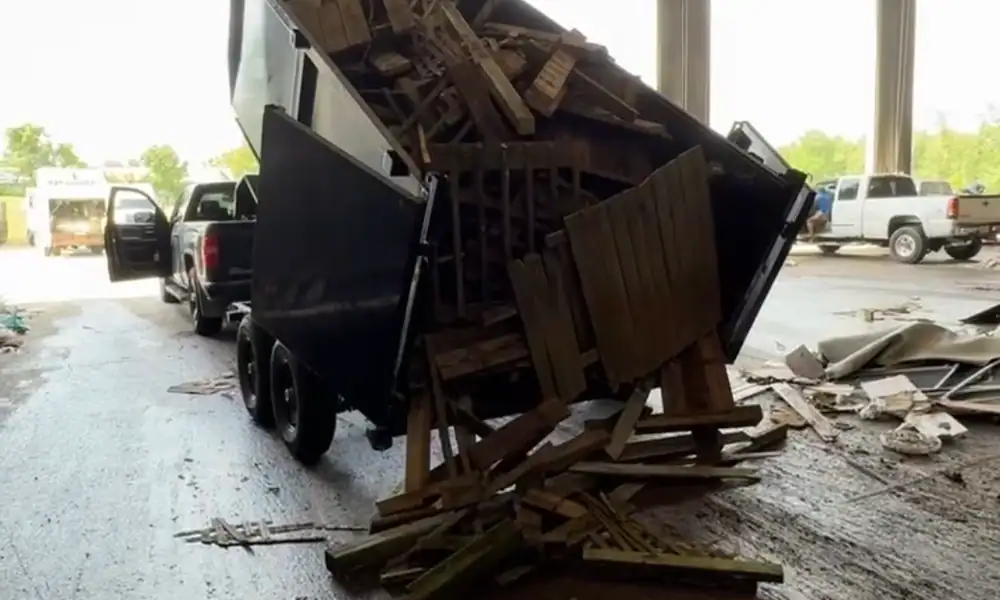
Everything removed is loaded and taken away by us.
Published ranges, because almost nobody in this market will give you a number before a site visit. You get a firm figure before anything starts and only pay for work completed.
A small platform or a modest porch, freestanding or lightly attached.
The common job: a full-width rear deck with steps, rails and footings.
Multi-level decks, raised decks with long posts, and roofed or screened porches.
These are Crown’s own published deck and porch ranges, split across the tiers people ask in. Concrete footings are included; a full concrete patio underneath the deck is concrete removal and is priced by weight.
Four steps, no obligation, and you only pay for work completed.
One photo from the garden, one showing where it meets the house, and the rough dimensions.
If it is attached, we agree in advance what happens to the ledger and who is closing up the wall.
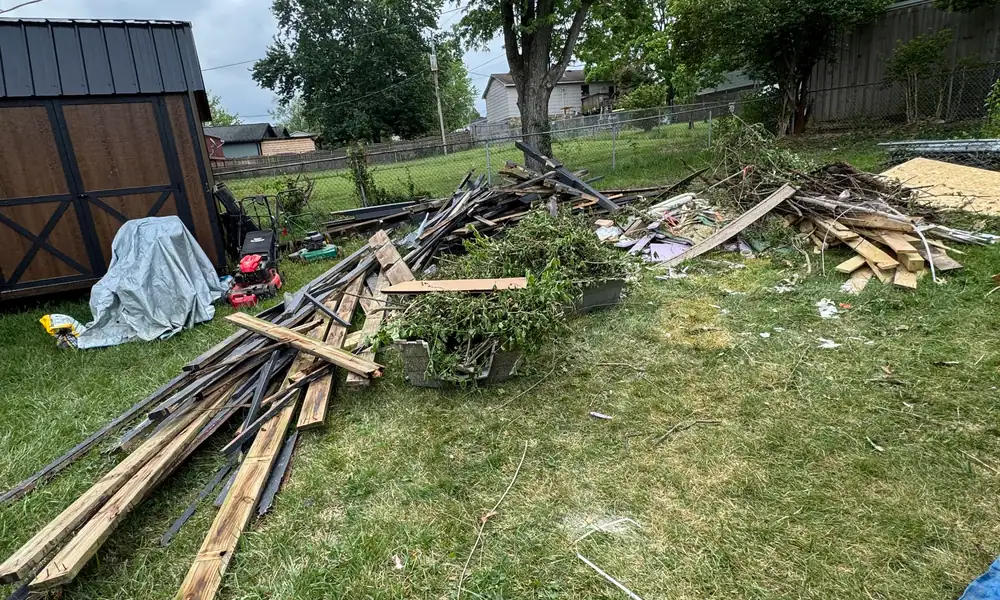
Boards, then frame, then footings, loaded as we go rather than stacked on the lawn.
Footing holes backfilled and raked, debris gone, and we show you the wall before we leave.
Very quick from contact to in home to remove some flooring. Once on site they got straight to work and did an outstanding job! Very reasonable price for the work done. Will continue to use them for all future needs.
Extremely helpful and nice, was hired for land clearing and site preparation they removed pesky honey suckle. Definitely going to hire them in the future.
Very hard workers that cleaned out a whole house that was trashed and filthy. Very polite and considered. Would definitely recommend this company!
Based in Lexington, working the counties around it. Send the address rather than the town: access decides more than distance on most of these jobs.
Answered properly rather than deflected to a phone call.
Send two or three photos. If it is really a different service we will say so and point you at the right page. It costs you nothing either way.
Send photos insteadIt leaves a wall that needs attention, and this is the single most important thing to plan for. An attached deck is bolted through a ledger board into the framing, usually through the siding, so removing it exposes bolt holes and whatever flashing was, or was not, behind it. We take the ledger off and show you the wall. Closing it up properly is siding and carpentry rather than demolition, so it is a separate scope, and it should be somebody’s job before the weather turns rather than a discovery afterwards.
Yes, they are part of Crown’s deck and porch scope rather than an extra. The usual choice is between digging them out entirely and cutting them below grade and backfilling, and which is right depends on what the ground is becoming: a lawn is fine over a cut-off footing, whereas anything you are building on or planting deeply is not. Tell us the plan for the space and we will tell you which one you want.
No, and this is worth knowing before somebody offers to take it off your hands for a bonfire. EPA states that prior to 2004 wood treated with chromated arsenicals was used in residential structures “such as decks and playsets”, and that manufacturers voluntarily stopped making it for homeowner use in December 2003. Its guidance is explicit: “do not burn CCA or other preservative-treated wood in a residential setting to avoid possible inhalation of toxic chemicals in the smoke and ash.” If your deck predates 2004, assume it is treated. It leaves on our trucks.
The take-down is similar; the disposal is not. Composite boards are not timber and do not go the same route, which is one of the reasons haul-off is priced into the job rather than left to you. Tell us which you have when you send photos: from a distance the two look much the same and they do not weigh the same.
Most standard decks are a single day including the footings. What extends it is height, a roof or screening over it, or footings that turn out to be considerably deeper than the posts suggested. You get a time with the price.
Lexington and the surrounding counties: Lexington, Georgetown, Nicholasville, Richmond, Frankfort, Winchester, Versailles and Paris. The ZIP codes are listed above. Decks are one of the jobs where a photo of the approach matters, because a rear garden with no side access is a different day’s work.
One photo from the garden, one showing where it meets the house, and the rough dimensions. If it is attached, we will talk about the wall before we start rather than after.