
Driveways & Aprons
Usually the heaviest job on a house
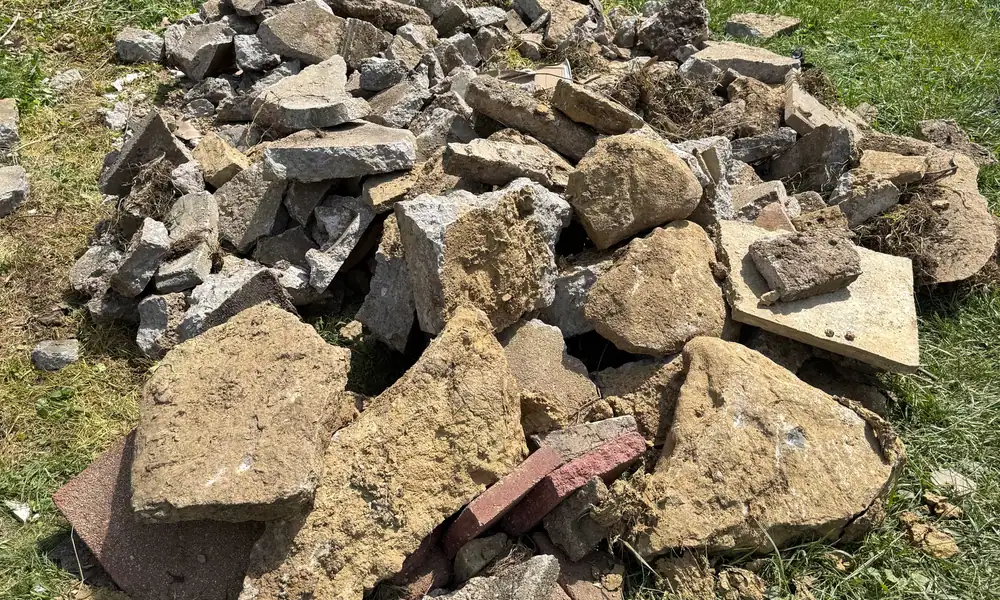
Concrete drives, aprons and parking pads broken out and removed.
Driveways, patios, slabs, sidewalks and foundations broken out and taken away. This is the one job on this site priced by weight, and the weight surprises people.
5.0 · 56 Google reviews (opens the Google listing in a new tab)
Licensed · Bonded · Insured · EPA compliant
Nobody else in this market shows you this, and it takes one minute. It is also why two quotes for "a patio" can be hundreds of dollars apart.
Start with the density. Ordinary structural concrete runs to roughly 150 pounds per cubic foot. A four-inch slab is a third of a foot thick, so every square foot of it weighs about fifty pounds. That single figure does most of the work.
Now your slab. A modest 12 × 20 patio is 240 square feet. At four inches that is roughly 12,000 pounds, six tons. The same patio poured at six inches is nine tons. Nothing about the surface you are looking at changed; the job did.
Which is why thickness beats area. Doubling the depth doubles the weight, the loads and most of the labour. Doubling the area does the same, but you can see the area from the kitchen window and you cannot see the depth, so the depth is the one that surprises people. It is also why a contractor who quotes concrete from a photo without asking how thick it is has not really quoted it.
And where it goes afterwards. Concrete is the one demolition material with a real second life. EPA’s 2018 figures put about 313 million tons of construction and demolition debris into aggregate next-use against 144 million tons landfilled, most of that recovered tonnage being concrete. Worth asking any contractor which of those two your driveway joins.
🔶 PLACEHOLDER: Crown’s own disposal route for broken concrete goes here. The national figures above are EPA’s and are not a claim about where Crown’s material goes; nothing on crownclearing.com states it either way, and it is not a thing to assume. The 150 lb/cu ft figure is the standard density for ordinary concrete and the arithmetic above is shown so you can check it.
Published ranges, because almost nobody in this market will give you a number before a site visit. You get a firm figure before anything starts and only pay for work completed.
A patio, a path or a small pad. Thin, unreinforced, and reachable.
The common job. Thickness and reinforcement decide where in the band you land.
Footings, stem walls, and anything with heavy rebar through it.
These are Crown’s own published concrete ranges, split across the tiers people ask in. If the concrete is under a structure that is also going, read shed and outbuilding removal; the two are usually quoted together.
Crown’s own scope is driveways, slabs, sidewalks and foundations. The differences between them are depth and what is inside them.
Usually the heaviest job on a house
Concrete drives, aprons and parking pads broken out and removed.
Often thinner, and often the easiest
Patio slabs, paths and garden walkways, plain or reinforced.
The second half of an outbuilding job
Shed, garage and outbuilding pads taken back to ground.
Frequently a city-adjacent job
Sidewalk panels, curbing and edging removed.
The heaviest concrete on a residential site
Old foundations, footings and stem walls broken out.
Priced in, not added at the end
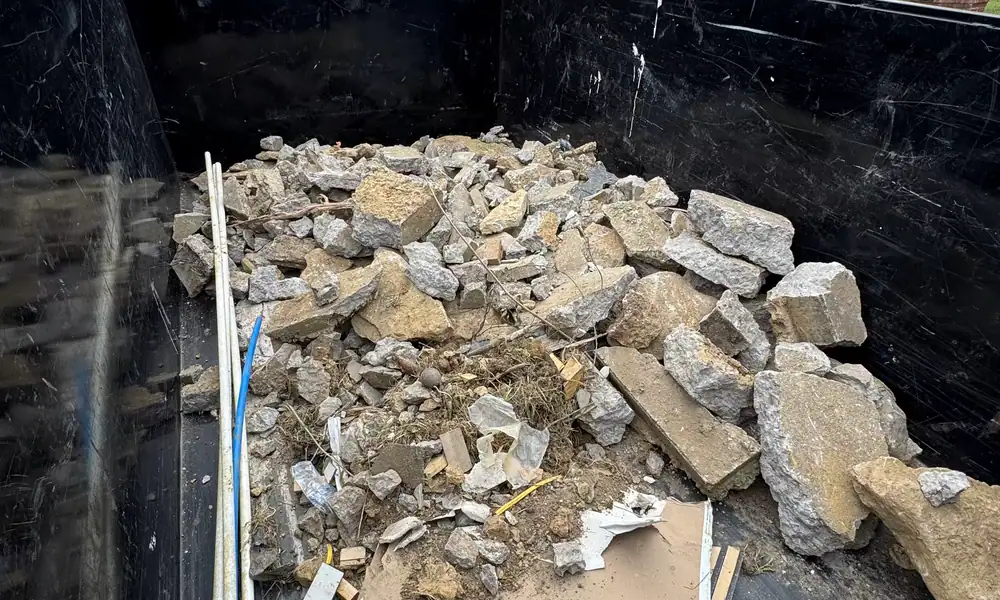
Everything broken out is loaded and taken away by us.
Four steps, no obligation, and you only pay for work completed.
Photograph the slab with something for scale, and measure the area and the depth at a broken edge if you can see one.
We work out what is actually coming out, because that is what sets the price and the number of loads.
The slab is broken into liftable sections and loaded as we go rather than stacked on your lawn.
Ground raked level, debris gone, and we walk it with you before we leave.
Very quick from contact to in home to remove some flooring. Once on site they got straight to work and did an outstanding job! Very reasonable price for the work done. Will continue to use them for all future needs.
Extremely helpful and nice, was hired for land clearing and site preparation they removed pesky honey suckle. Definitely going to hire them in the future.
Very hard workers that cleaned out a whole house that was trashed and filthy. Very polite and considered. Would definitely recommend this company!
Based in Lexington, working the counties around it. Send the address rather than the town: access decides more than distance on most of these jobs.
Answered properly rather than deflected to a phone call.
Send two or three photos. If it is really a different service we will say so and point you at the right page. It costs you nothing either way.
Send photos insteadBecause you are not paying for the area, you are paying for the weight and the loads it takes to move it. Concrete runs to roughly 150 pounds per cubic foot, which puts a four-inch slab at about fifty pounds for every square foot of it. A timber deck of the same footprint might be a tenth of that. The section above does the arithmetic properly: it is the single most useful thing to understand before you get quotes on concrete.
Look at a broken edge, an expansion joint, or where the slab meets a drain or a step: almost every slab shows its depth somewhere. Residential patios and paths are commonly around four inches; drives and garage pads are often five or six; anything carrying vehicles or built as a foundation can be a great deal more. If you can photograph an edge with a tape or a coin against it, that one photo improves the quote more than any other.
Often, and it changes the method rather than the possibility. Wire mesh is common in residential slabs and slows the break-out; proper rebar, usually in drives, foundations and anything structural, has to be cut as the slab comes apart. You can sometimes see the ends at an edge or a saw cut. If you cannot tell, say so: we would rather assume it is there and be right than quote as if it is not.
Broken concrete is one of the few demolition materials with a genuine second life: EPA’s figures for 2018 put around 313 million tons of construction and demolition debris into aggregate next-use, against 144 million tons landfilled. It is worth asking any contractor where your material actually goes, because "hauled away" and "recycled" are not the same sentence.
Yes, and it is common: a section by a garage door, an apron at the curb, a strip being replaced. Partial removal means a saw cut to give a clean edge, which is a small extra step and worth mentioning when you send the photos so the quote includes it rather than adds it.
Lexington and the surrounding counties: Lexington, Georgetown, Nicholasville, Richmond, Frankfort, Winchester, Versailles and Paris. The ZIP codes are listed above. Concrete is the one job where distance matters least and access matters most, because the weight rather than the mileage sets the number of loads.
Photograph the slab with something for scale, and measure the area and the depth at a broken edge or expansion joint if you can see one. The depth is the photo that changes the quote.