
Concrete Drives & Pads
The job that sells the rest of the visit
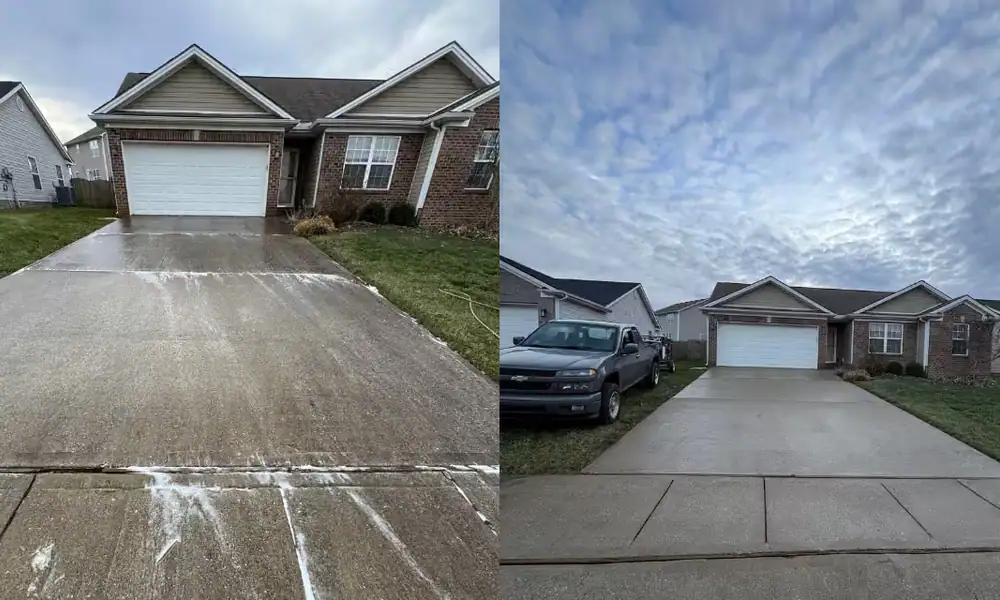
Poured concrete drives, aprons and parking pads. The highest-contrast result of anything on this site, which is also why the halfway photo is the one everybody takes.
Flat concrete is the one surface where pressure genuinely is the tool. It is also where the most obvious bad workmanship in this trade shows up, and you can see it from the street for years afterwards.
5.0 · 56 Google reviews (opens the Google listing in a new tab)
Licensed · Bonded · Insured · EPA compliant
Published ranges, because almost nobody in this market will give you a number before a site visit. You get a firm figure before anything starts and only pay for work completed.
Crown’s published range for this service. Area decides most of it.
The site publishes one band for flatwork and nothing for stain treatment as a separate line. The axis is area plus named stain steps, so that is what any figure past the band should be built on.
The $150 to $350 figure is Crown’s own published driveway and sidewalk range, carried from the pressure washing hub unchanged, where it is described as the most visible result per dollar on the page. That is a fair description. If the concrete is breaking up rather than dirty, that is concrete removal and a completely different price.
If you have ever seen a driveway with faint light and dark bands arcing across it, you have seen this. It is the most common bad outcome in this trade and it is entirely a question of which tool was used.
A wand is a single jet on the end of a stick. It cleans a narrow line, and the operator sweeps it side to side. Wherever two sweeps overlap, the concrete gets cleaned twice. Wherever they do not quite meet, it gets cleaned once. The result is a regular pattern of lighter and darker bands (striping), and on a large slab it is unmistakable.
A surface cleaner is a hood with rotating jets underneath. It holds a fixed standoff from the slab and covers a wide path at a constant rate, so every square inch gets the same treatment. That is the entire difference, and it is mechanical rather than a matter of skill.
You cannot fix it by going over it again. The stripes are a difference in how much surface soiling was removed, so a second pass over the whole slab just produces a cleaner slab with the same pattern, slightly fainter. It stays visible until the concrete weathers back to uniform, which takes seasons.
Which is why the wand still has a job. Edges, expansion joints, the strip against the garage door and anything the hood cannot reach are done deliberately with a wand, after the open area is finished. Using it as the primary tool is the mistake; using it for the last ten percent is the method.
If your driveway already has striping from a previous clean, say so when you send photos. It does not change the method, but it changes what a realistic result looks like, and we would rather set that expectation at quote.
Most of this is ordinary poured concrete, but other flatwork surfaces turn up regularly and one of them needs a different answer.
The job that sells the rest of the visit
Poured concrete drives, aprons and parking pads. The highest-contrast result of anything on this site, which is also why the halfway photo is the one everybody takes.
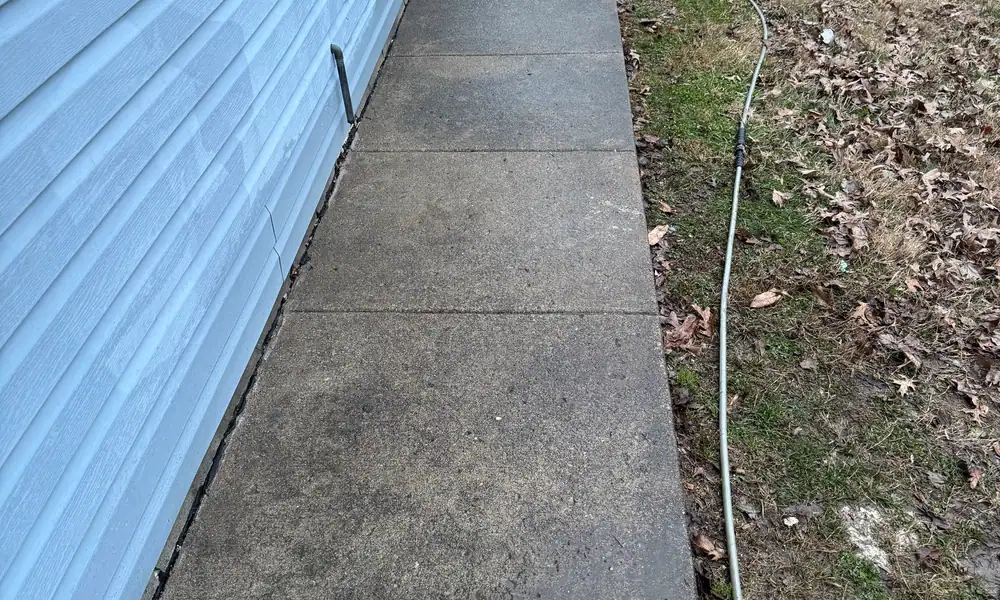
Small area, disproportionate effect
Front paths, public sidewalk sections and garden walkways. Cheap to add to a driveway visit and the part visitors actually walk on.
Where technique changes
Pavers have sand joints that pressure will strip out, and stamped concrete has a sealer that pressure will haze. Both are cleaned more gently, and re-sanding or resealing afterwards is a separate decision.
Not a pressure problem
Oil has soaked into the slab rather than sitting on it, and no amount of pressure lifts it. It is a degreasing step with dwell time. Same with rust and battery marks: different chemistry, separate step.
Four steps, no obligation, and you only pay for work completed.
Send photos of the worst of it and the whole elevation. A number is guaranteed within two hours during business hours, no site visit needed for most of these.
Oil, rust and organic staining get their own treatment and their own dwell time before anything else happens. Skipping this is why some driveways come up patchy.
A rotating surface cleaner covers the area at an even standoff, which is what produces one consistent finish instead of a pattern.
A wand is used deliberately for edges, joints and corners the surface cleaner cannot reach, then the whole slab is rinsed down so nothing dries where it lands.
Very quick from contact to in home to remove some flooring. Once on site they got straight to work and did an outstanding job! Very reasonable price for the work done. Will continue to use them for all future needs.
Very hard workers that cleaned out a whole house that was trashed and filthy. Very polite and considered. Would definitely recommend this company!
Extremely helpful and nice, was hired for land clearing and site preparation they removed pesky honey suckle. Definitely going to hire them in the future.
Based in Lexington, working the counties around it. Send the address rather than the town: access decides more than distance on most of these jobs.
Answered properly rather than deflected to a phone call.
Send two or three photos. If it is really a different service we will say so and point you at the right page. It costs you nothing either way.
Send photos insteadCrown publishes $150 to $350, and that is the same figure as the main pressure washing page. Area is the main axis. It is the cheapest thing on that page and the one that changes the look of a property most per dollar, which is why it is usually the first thing people book and rarely the only thing.
Because they were cleaned with a wand rather than a surface cleaner. A wand cleans a narrow line and the operator sweeps it, so overlaps get cleaned twice and gaps get cleaned once, producing light and dark bands. A rotating surface cleaner holds an even standoff across a wide path and does not. Going over it again does not remove the pattern; it just makes it fainter.
Often, substantially, but be realistic: oil has soaked into the slab rather than sitting on it, and how much lifts depends on how long it has been there and how deep it went. It is a degreasing treatment with dwell time, not a pressure problem: more pressure does nothing at all. Send a photo of the patch and we will tell you honestly what to expect.
Not if they are cleaned as pavers. The sand in the joints will strip out under full pressure, so pavers are cleaned more gently, and re-sanding afterwards is a normal follow-up rather than a sign something went wrong. Tell us the patio is pavers when you send photos so it is quoted as one.
Yes, and it is cheap to add once we are set up on your driveway. It is a small area with a disproportionate effect, because it is the part everyone actually walks on.
Cleaning will make it look better and will not make it sound. If the slab is breaking up, heaving or spalling badly, the honest answer is that you are looking at concrete removal and a replacement pour, priced on a completely different axis. We will say so rather than sell you a wash.
Send a photo of the whole slab and a close-up of any oil or rust. Rough dimensions help. A firm number comes back within two hours, guaranteed, with any stain treatment named as its own line rather than buried.