
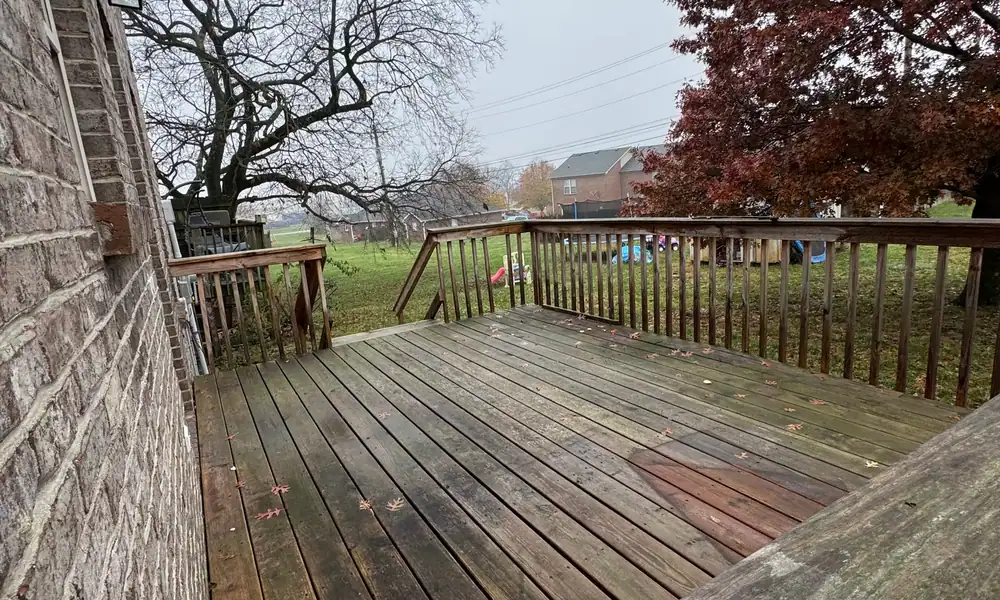
Pressure-Treated Softwood
The most common deck here
Southern yellow pine and similar. Soft, and it furs if you push it: the grain lifts and the board goes fuzzy. Cleaned at low pressure with solution doing most of the work.
Most deck cleaning is booked as the first half of a staining job, and that is the useful way to think about it. What decides the schedule is not the washing: it is how long the wood takes to dry afterwards.
5.0 · 56 Google reviews (opens the Google listing in a new tab)
Licensed · Bonded · Insured · EPA compliant
This is the thing most people find out too late, usually from a painter standing on a deck that is not ready. Worth knowing before you book either of us.
Washing puts a large amount of water into the timber. Wood is porous and it takes it up. A deck that looks dry on the surface an hour later can still be carrying a great deal of moisture a quarter of an inch down, which is exactly where a stain needs to key into.
Stain applied to wet wood does not bond. It sits on the surface, dries unevenly, and lifts within a season or two. It is one of the most common reasons a deck finish fails early, and from the outside it looks like the stain was bad rather than the timing.
So the sequence has a gap in it. Wash, then wait for dry weather, then stain. How long depends on the species, how thick the boards are, how much sun that deck gets and what the week is doing, which is why we give you a number for your deck rather than a rule.
Plan the wash around the forecast, not the other way round. If your painter is booked for Saturday, the wash wants to happen early in a dry week, not on the Friday. Tell us the staining date when you ask for a price and we will work backwards from it.
🔶 PLACEHOLDER: the dry-time figure above needs Crown’s own number, and your stain manufacturer’s instructions govern regardless. Most published guidance for softwood decking sits in a 24 to 72 hour band depending on conditions; 48 is shown as a common midpoint and should be replaced with what Crown actually tells customers, or removed.
Different materials turn up on Central Kentucky decks and patios, and the pressure that is right for one is wrong for the next.
The most common deck here
Southern yellow pine and similar. Soft, and it furs if you push it: the grain lifts and the board goes fuzzy. Cleaned at low pressure with solution doing most of the work.
Softer than it looks, or much harder
Cedar is softer than pressure-treated pine and marks more easily. Dense hardwoods take more but show any inconsistency in the finish. Both are worth identifying before anyone starts.
Not maintenance-free, whatever the brochure said
Composite does not rot, which is not the same as staying clean. Mold and algae grow in the embossed grain and need solution rather than force, and excess pressure can permanently mar the surface texture.
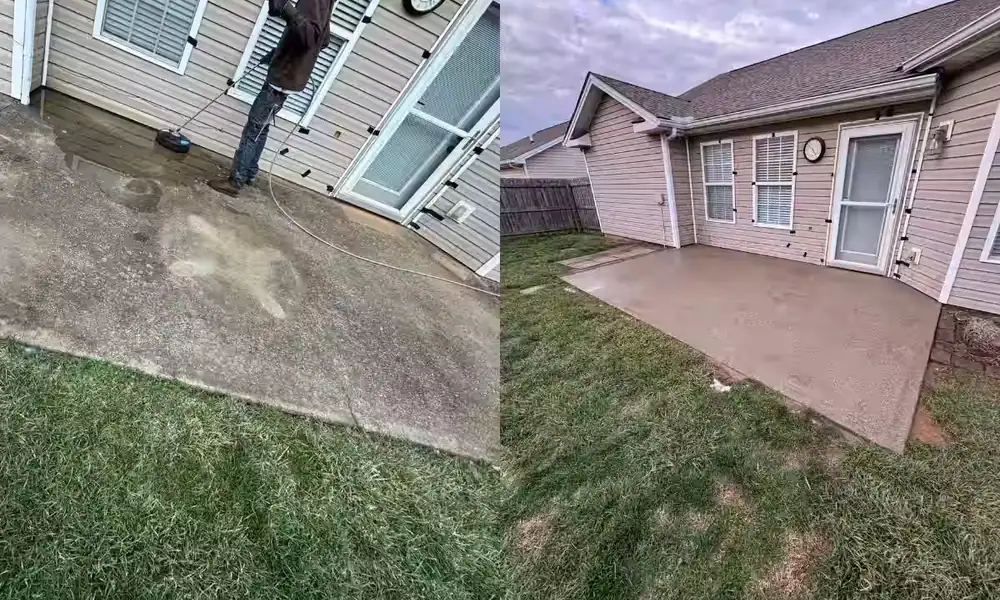
The easy one
A patio is flatwork and behaves like flatwork. If it is the main thing you want done, it may price better under driveway and sidewalk cleaning.
Published ranges, because almost nobody in this market will give you a number before a site visit. You get a firm figure before anything starts and only pay for work completed.
Crown’s published range for this service. Material and layout decide where inside it you land.
The site publishes one band and no separate figure for preparation to a finishable standard. The axis is area, material and the standard required, so that is what a number past the band should be built on.
The $150 to $400 figure is Crown’s own published deck and patio range, carried from the pressure washing hub unchanged, where it notes that timber takes longer because it takes less pressure. That is exactly right and it is the whole reason this page exists separately. If the deck is coming out rather than being cleaned, that is deck and porch demolition.
Four steps, no obligation, and you only pay for work completed.
Send photos of the worst of it and the whole elevation. A number is guaranteed within two hours during business hours, no site visit needed for most of these.
Softwood, cedar, hardwood and composite all take a different pressure. Getting this wrong is what produces a furred deck, and it is not recoverable without sanding.
The cleaner lifts the growth out of the grain and the rinse carries it away. On timber the rinse follows the grain rather than crossing it.
If you are staining, we tell you how long to leave it before you or your painter starts. That number is the difference between a finish that holds and one that peels in a season.
Very quick from contact to in home to remove some flooring. Once on site they got straight to work and did an outstanding job! Very reasonable price for the work done. Will continue to use them for all future needs.
Very hard workers that cleaned out a whole house that was trashed and filthy. Very polite and considered. Would definitely recommend this company!
Extremely helpful and nice, was hired for land clearing and site preparation they removed pesky honey suckle. Definitely going to hire them in the future.
Based in Lexington, working the counties around it. Send the address rather than the town: access decides more than distance on most of these jobs.
Answered properly rather than deflected to a phone call.
Send two or three photos. If it is really a different service we will say so and point you at the right page. It costs you nothing either way.
Send photos insteadIt can, and the failure has a name: furring. Softwood decking is soft enough that too much pressure lifts the grain, leaving the boards fuzzy and rough. It is not recoverable by washing it again: it needs sanding. Timber is cleaned at low pressure with the solution doing the work, which is slower, and that is why the hub page says timber takes longer because it takes less pressure.
Longer than the surface suggests. Washing drives water into the timber, and stain applied over damp wood does not bond: it sits on top and lifts within a season. You want dry weather in between, and the exact number depends on the species, board thickness and how much sun that deck gets. Tell us your staining date and we will work backwards from it.
Yes, more often than people expect. Composite does not rot, but mold and algae grow happily in the embossed grain pattern, and that is what makes an older composite deck look dull and green. It is cleaned with solution rather than force: too much pressure can permanently mar the surface texture, which no amount of cleaning brings back.
Crown publishes $150 to $400, the same figure as the main pressure washing page. Material and layout move it more than raw area does: spindles and steps are the slowest square footage on any deck, and softwood is slower than concrete because it has to be treated gently.
Yes, and you should. Several surfaces on one visit is one mobilization rather than several, which is where the saving is. If the patio is the main job and the deck is incidental, driveway and sidewalk cleaning may be the better line to price it under.
Cleaning will show you exactly how much is rotten, which is genuinely useful and is sometimes the point. It will not fix any of it. If a meaningful number of boards are going, you are looking at repair or at deck and porch demolition, and we would rather tell you that from the photos than take the money first.
Send a photo of the whole deck and a close-up of the boards, and say whether it is softwood, cedar or composite. If you are staining afterwards, tell us the date: the dry time matters more than the wash.