Published
Television lies to you about DIY interior demolition. Thirty seconds of a presenter driving a sledgehammer through a partition, a commercial break, and the room reappears bare and swept. What the edit eliminates is the eleven hours of loading, the trip to the transfer station, and the moment somebody discovers that the wall they just opened contains a pressurised copper supply line.
Demolition is the single most underestimated phase of any Central Kentucky renovation, and the explanation is straightforward arithmetic. The teardown resembles the easy part because no discernible skill appears to be involved. The skill consists entirely of knowing what not to hit.
Here is the consideration that matters to anyone running numbers on a Lexington flip or a rental turn: demolition rarely generates the saving people anticipate once tool rental, disposal expenditure, and the repair bill for accidental damage have all materialised. Occasionally it exceeds the quote you declined.
Crown Clearing & Removal provides insured interior demolition for kitchens, bathrooms and full-home guts across Lexington and Central Kentucky. Call (859) 213-6077 before you swing that hammer, and the estimate is free whether or not you book.
Danger 1: You Cannot Identify a Load-Bearing Wall by Looking at It
A partition wall supports nothing beyond its own weight and whatever is fastened to it. A load-bearing wall transfers accumulated roof and floor loads downward through the structure to the foundation. Viewed from the occupied side of the drywall, finished identically and painted the same colour, the two assemblies are visually indistinguishable.
Guessing wrong is the most expensive error available to an amateur.
The distinction matters disproportionately throughout the older housing inventory around Chevy Chase, Ashland Park and the pre-war neighbourhoods adjacent to downtown. Contemporary subdivisions employ engineered roof trusses that span the entire width of the building and bear exclusively on exterior walls, which leaves interior partitions genuinely non-structural. Residences constructed before approximately 1960 were framed conventionally with rafters and ceiling joists, where interior walls frequently carry a bearing load and occasionally support a ridge through a partition nobody ever documented.
The failure mechanism is rarely dramatic. Immediate collapse is uncommon. What develops instead is a progressive ceiling deflection over the subsequent fortnight, upstairs doors that cease latching correctly, and a recurring drywall crack that reopens every time somebody repairs it, which is precisely how a weekend project escalates into a structural engineer’s report and an installed steel beam.
Our crews strip finishes off framing without altering what the framing is doing. Where a wall genuinely needs to come out, that is a conversation involving temporary shoring and a proper header, not a reciprocating saw and optimism.
Danger 2: Asbestos and Lead Paint Are Common in Pre-1978 Finishes
Two hazardous materials sit in the exact assemblies an interior gut disturbs first, and both become dangerous specifically when they are broken up, abraded or sanded. Intact, they are generally stable. Demolition is the activity that converts them from inert to airborne.
Lead paint is presumed present in housing constructed before 1978 unless laboratory testing demonstrates otherwise, and a substantial proportion of Fayette, Clark and Bourbon County housing predates that threshold comfortably. Dry-sanding, scraping or hammering painted surfaces generates fine lead-bearing dust that migrates into carpet fibres, subfloor seams and ductwork, where it persists long after the renovation concludes. Children and pregnant women face the most serious exposure consequences, and the particulate is invisible.
Asbestos appears in vinyl floor tile and its black mastic adhesive, pipe and duct insulation, textured ceiling treatments, and older formulations of joint compound. A reciprocating saw through pipe insulation, or a scraper applied to nine-inch floor tile, liberates respirable fibres directly into the air you continue breathing for the remainder of the afternoon.
The federal framework here is worth understanding even if you never hire anyone. The EPA Renovation, Repair and Painting Rule (opens in a new tab) requires that anyone paid to perform work disturbing paint in pre-1978 housing be certified in lead-safe work practices, including sole proprietors. Kentucky has no state-run programme of its own and operates under the federal rule, administered through EPA. Crown Clearing is an EPA Lead-Safe Certified Firm, which is a credential most general demolition outfits in this market do not carry, and it is worth asking any contractor to produce theirs before they start.
Containment, negative pressure, HEPA filtration and wet methods are the difference between a controlled strip-out and contaminating a house you are about to sell.
Danger 3: Live Wires and Water Lines Sit Inside the Walls You Are Opening
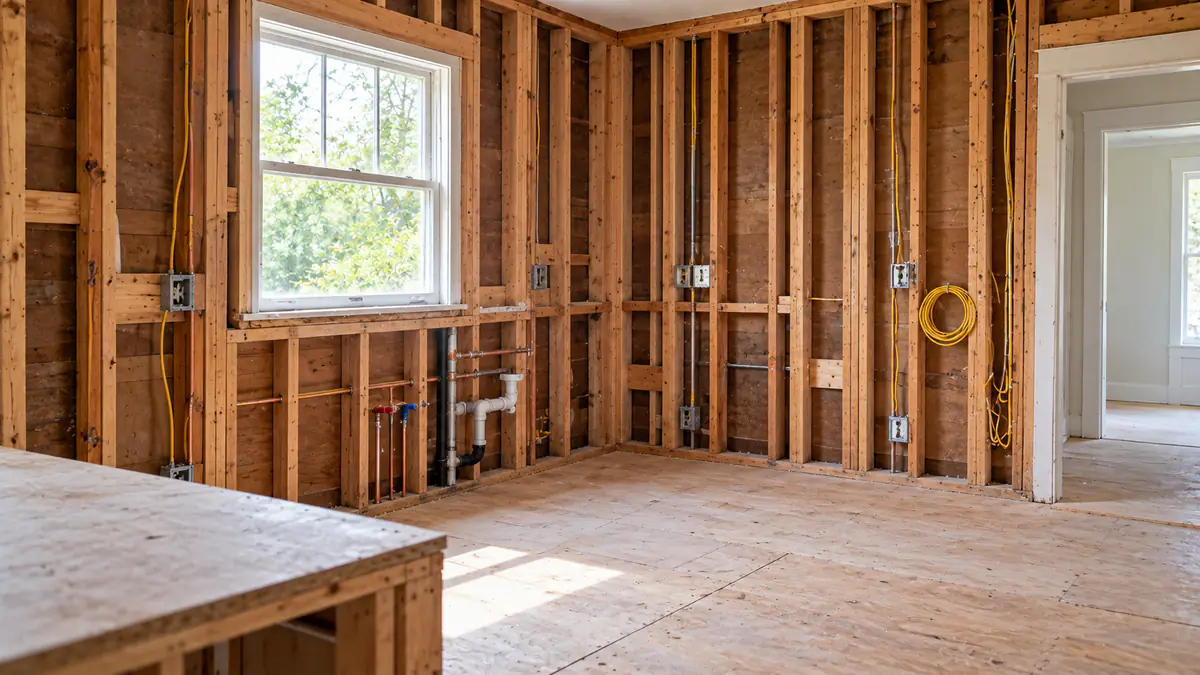
Everything that makes a house habitable runs through the cavities you are about to open blind. Branch circuits at 120 volts, dedicated 240-volt runs feeding ranges, dryers and air handlers, supply lines in copper or PEX under household pressure, drain and vent stacks in cast iron or ABS, and low-voltage runs for thermostats and alarms.
A blade through an energised conductor can arc, start a concealed fire inside the stud bay, or kill you.
A blade through a pressurised supply line is less lethal and considerably more expensive, because water under pressure finds the subfloor within seconds and the ceiling below within minutes. By the time you locate the stop valve, you have added flooring, insulation and a drywall repair to a project that was supposed to be subtractive. In a two-storey house, you have also added the ceiling of the room underneath.
Circuits in older Lexington homes are frequently not labelled accurately at the panel, and a kitchen remodel routinely uncovers a circuit that feeds something in another room entirely. Killing the breaker you believe serves the space is not verification. A non-contact tester on every conductor before cutting is verification.
We trace, isolate and cap around utilities, then leave the space in a condition your plumber and electrician can work in immediately rather than one that starts their day with an emergency.
Danger 4: What Does Demolition Debris Actually Weigh?
Far more than almost anyone estimates, and this is the danger that converts a one-weekend plan into three.
Half-inch drywall runs roughly 1.6 to 1.7 pounds per square foot, so a single 4x8 sheet weighs around 50 pounds. That is the light case. Plaster over wood lath, which is what you will find in most pre-war Central Kentucky construction, runs several times heavier per square foot, and ceramic tile set over a mortar bed is heavier still.
What a 10x10 Kitchen Gut Puts in Your Driveway
Work a modest example. A ten-by-ten kitchen with eight-foot ceilings presents roughly 320 square feet of wall surface plus a 100 square foot ceiling. In drywall, that assembly alone is around 700 pounds before you have removed a single cabinet. In plaster and lath, the same room approaches a ton, and then you add:
- Cabinetry and countertops. Base and wall cabinets with a stone or laminate top frequently exceed 500 pounds for a modest galley layout, and stone fabricators will not take your old top back.
- Flooring and underlayment. Tile with its mortar bed, or multiple layers of sheet vinyl over plywood underlayment accumulated across decades of previous remodels, both weigh substantially more than the flooring you see.
- Appliances. A range, dishwasher and refrigerator carry disposal restrictions of their own, and anything containing refrigerant cannot simply be left at the kerb.
- The things nobody counts. Trim, doors, plumbing fixtures, light fittings, and the fasteners, nails and dust that make up the final several wheelbarrow loads.
A half-ton pickup has a payload capacity around 1,000 to 1,500 pounds depending on configuration. A plaster kitchen therefore represents multiple fully loaded trips, and overloading the truck is both illegal and a genuine way to lose control of a vehicle. People do it anyway, because by trip four they stop caring.
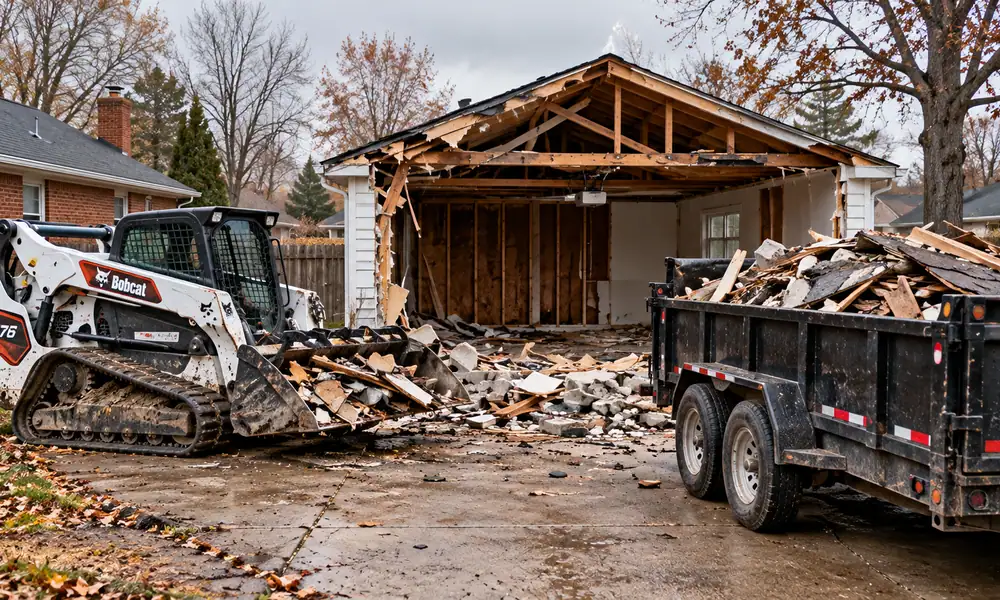
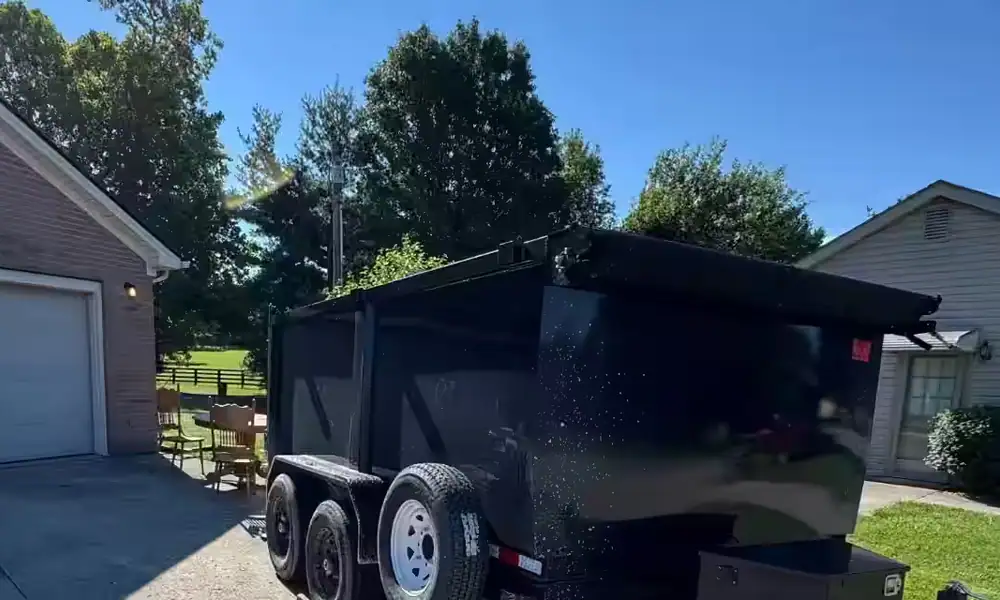
This is where DIY demolition economics break down completely. You have now done the job twice: once demolishing, once moving the result by hand. If you only need the container, our 15-yard dumpster rental covers a standard seven to ten days at $280 to $540 and you load it at your own pace. If you would rather the material simply leave, construction debris removal means it goes in our trucks instead of yours.
Danger 5: Hidden Mould and Rotted Framing Expand the Job
Open a bathroom wall and there is a reasonable chance of finding what a slow leak has been doing behind the tile for years. Rotted bottom plates, delaminated subfloor around the toilet flange, soft sheathing behind the shower surround, and active mould growth across the back of the substrate.
This is the scope-creep moment that defeats most amateur demolition.
Two wrong responses follow, and both are common. The first is panic demolition, tearing into contaminated material dry and distributing spores through the house and the return air system, which converts a localised problem into a whole-house one. The second is concealment, closing the cavity back up with new board over damp rotted framing, which hands the problem to a buyer, a home inspector, or your own tenant in eighteen months.
The correct sequence is unglamorous: isolate the affected area, control dust, remove compromised material back to sound framing, let the cavity dry properly, and treat before anything gets closed in. We strip the rot out and hand over a dry, clean substrate, and when the damage extends into structural framing we say so rather than quietly boarding over it.
Does DIY Interior Demolition Actually Save Money in Lexington?
Usually less than expected, and on pre-1978 property with plaster walls it frequently costs more. The saving looks obvious because labour is the visible line item, and the costs that replace it are the ones nobody forecasts.
What DIY Interior Demolition Really Costs
Price it honestly. You need a container or a vehicle and multiple disposal runs. You need a pry bar, reciprocating saw and blades, a respirator rated for the material rather than a dust mask, eye protection, gloves, and protective sheeting to contain the mess. You will spend two or three weekends on a room, which for a landlord is two or three weekends of an unoccupied unit generating nothing. Then you carry the entire risk of the four dangers above, uninsured, on your own property.
Against that, our interior gutting and strip-out work sits inside a published demolition range of $500 to $2,000 or more, with haul-off quoted inside the number rather than added at the end. A kitchen or bathroom strip-out is typically a single-day job for a crew that has done it several hundred times, including kitchen demolition, bathroom tear-outs and flooring removal.
For a flipper, the figure that genuinely determines the outcome is never the demolition quote itself but the accumulated holding cost of the additional fortnight, which appears on no invoice anywhere and consumes the margin regardless.
Why Central Kentucky Investors Hire Professional Interior Demolition Crews
Landlords and flippers reach the same conclusion by arithmetic rather than caution. Every day a unit sits mid-gut is a day of mortgage, insurance, utilities and taxes against zero rent, and a weekend crew moves at a fraction of the pace of one that does this daily with the right equipment.
You are not purchasing labour. You are purchasing a compressed timeline, insurance that absorbs the consequence if something goes wrong, the accumulated judgement to recognise a bearing wall and a regulated hazardous material before disturbing either, and debris that departs the same day in somebody else’s truck.
We are licensed, bonded, insured and EPA-compliant, and we hold EPA Lead-Safe Certified Firm status for work on pre-1978 housing. We own our trucks and dumpsters rather than brokering the job to whoever is free that week. The debris leaves with us instead of accumulating on your property. Fifty-six Google reviews, averaging 5.0.
Start Your Remodel on a Clean Slate
Send two or three photos of the room and your ZIP code. You get a firm number, free, guaranteed within two hours during business hours, whether or not you book the work. And if the honest answer is that you only need a dumpster, we will tell you that instead of selling you a crew.
Call (859) 213-6077 or request a free quote. Open Monday to Saturday, 8:00 AM to 6:00 PM, serving Lexington, Georgetown, Nicholasville, Richmond, Frankfort, Winchester, Versailles and Paris.
This guide is general information rather than a substitute for professional assessment. Lead and asbestos requirements are set by federal regulation and do change, and a qualified inspector is the authority on any specific property.