Published
You bought acreage in Woodford, Jessamine or Bourbon County, and the back forty is now an impenetrable thicket of bush honeysuckle, briars and volunteer locust. Every operator you call recommends whichever machine they happen to own. The forestry mulching contractor tells you a bulldozer will strip your topsoil. The dozer operator tells you mulching just hides the problem. Both of them are partly right.
Here is the verdict before the detail. In the forestry mulching vs land clearing comparison, mulching genuinely protects soil structure, but it leaves every root crown alive in the ground and buries your pasture under a chip mat. For most Central Kentucky properties, cutting the material and hauling it off produces usable ground faster and keeps the honeysuckle from returning thicker than before.
And the framing almost everyone uses is wrong. “Traditional clearing” is not one method, it is two, and conflating them is how landowners end up with a scraped, eroding lot they did not ask for.
Crown Clearing & Removal handles land clearing, pasture reclamation and site preparation across Central Kentucky. Call (859) 213-6077 to schedule a site walk, free and with no obligation.
What Does Traditional Land Clearing Actually Mean in Kentucky?
Traditional land clearing covers two fundamentally different operations that get discussed as though they were identical. One of them deserves its reputation. The other does not.
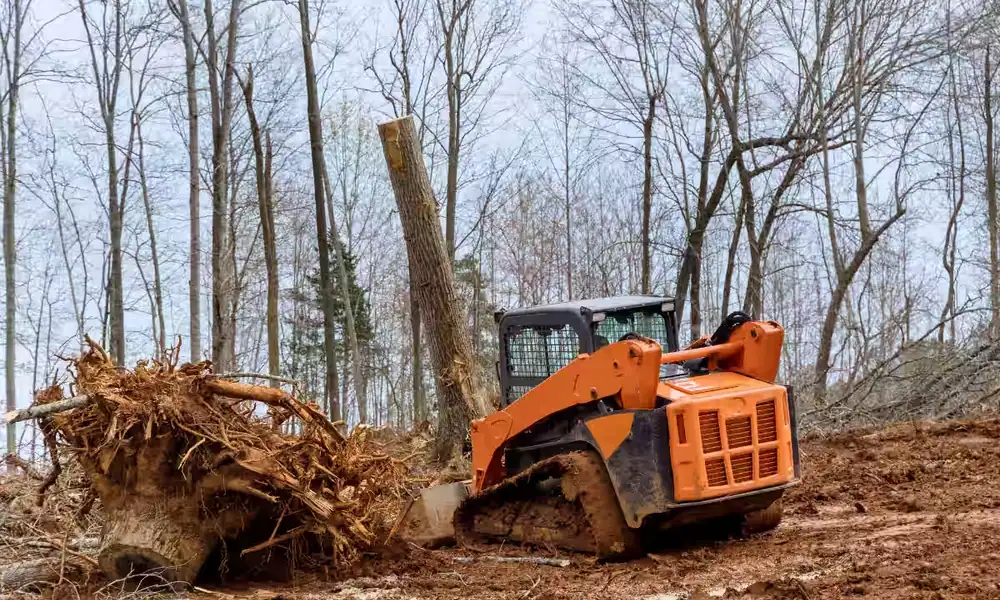
The version that earned the reputation is dozer clearing: a bulldozer equipped with a root rake displaces vegetation, root systems and a substantial quantity of soil into windrows, which are subsequently burned or buried on site. It is undeniably fast across large acreage and it is brutal on agricultural ground. Bluegrass topsoil occupies a relatively shallow horizon above clay subsoil and limestone bedrock, and once a dozer blade removes that horizon, the exposed remainder is compacted clay that sheds precipitation rather than absorbing it. The first substantial spring rainfall transports a meaningful proportion of your most valuable soil into the nearest drainage.
Then there is the burn pile complication, which rarely appears in the estimate.
Open burning is regulated at both state and county jurisdiction across Kentucky, restricted seasonally, and prohibited entirely in certain municipalities. A windrow of green honeysuckle also combusts inefficiently, smoulders for several days, and leaves a sterilised scar on the ground where the accumulation sat.
What Is Forestry Mulching, and What Does It Leave Behind?
Forestry mulching uses a single tracked carrier fitted with a rotary drum or disc mulching head that cuts standing vegetation and grinds it into chips in one pass, depositing the material directly onto the ground where it grew. Nothing is piled, nothing is burned, nothing leaves the property.
The advantages are real and worth stating plainly, because an honest comparison is more useful to you than a sales pitch.
Mulching never disturbs the soil horizon, so the topsoil and its established root structure survive intact. It deposits an immediate protective layer against raindrop impact and surface runoff. It is rapid across large, relatively open acreage, and because no trucking or disposal expenditure is involved, the cost per acre runs considerably lower than any method that relocates material off site. On a hundred acres of recreational timber ground, those advantages are decisive.
On a four-acre horse pasture in Versailles, they are not.
The Third Land Clearing Method Most Kentucky Landowners Never Hear About
Between dozer scraping and mulching sits the approach we actually use, and it is the one that rarely gets quoted to rural landowners because it requires more labour than running a single machine.
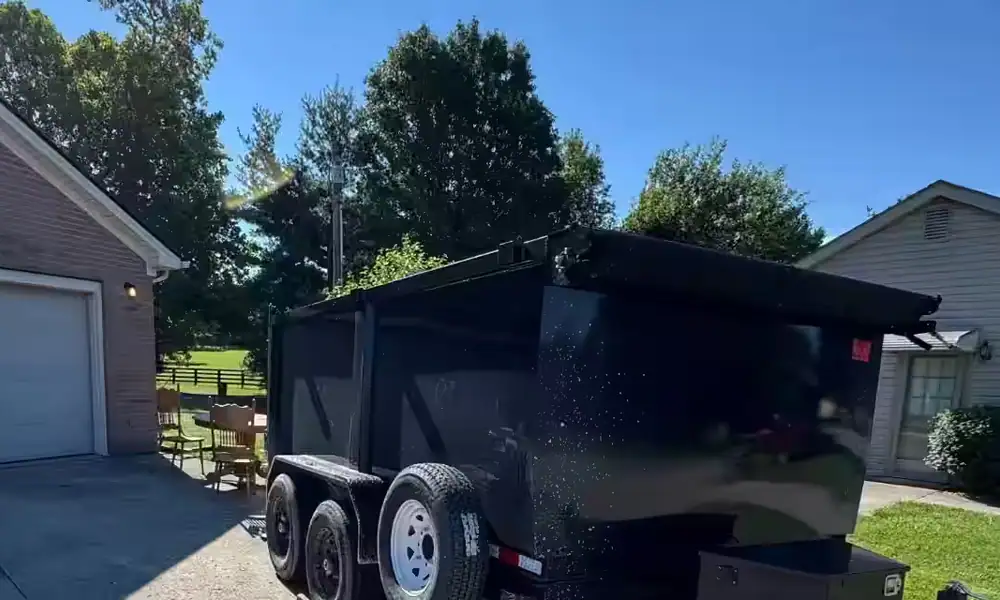
Vegetation is cut at or near ground level with a skid steer and hand crews rather than pushed over with a blade, which leaves the soil horizon undisturbed exactly as mulching does. The cut material is then loaded into our own trucks and dumpsters and hauled off the property entirely. Stumps are ground separately where the end use requires it. No windrows, no burning, no chip blanket, and critically, no blade ever contacts the soil profile.
You get the soil preservation of mulching and the clean finish of dozer work, without the drawbacks of either.
Why Haul-Off Land Clearing Usually Wins on Kentucky Soil
For properties under roughly fifteen acres that you intend to graze, build on, mow or fence, removal outperforms mulching on four counts. Three of them concern what happens underneath the surface, which is where the comparison is usually decided and almost never discussed.
Forestry Mulching Leaves Every Root Crown in the Ground
This is the argument that matters most in the Bluegrass, and it is not a marketing opinion.
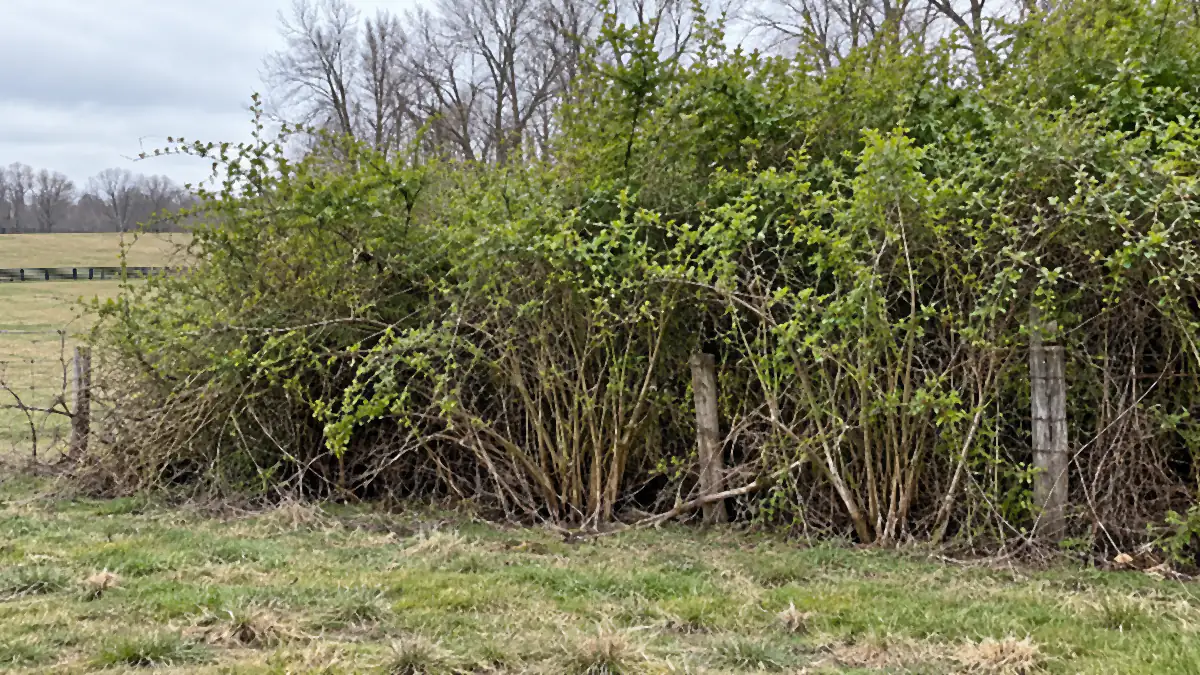
Bush honeysuckle is the dominant invasive woody species across Central Kentucky fencerows and woodlots. The University of Kentucky’s College of Agriculture describes bush honeysuckles as the most serious tree species across much of Kentucky (opens in a new tab), spread by birds into dense fencerow stands, and the extension guidance is unambiguous about control: these are perennials that regenerate primarily from their root systems, so effective control has to address the roots rather than the visible growth. Cut a stem and leave the stump untreated and more stems appear the following season than you started with.
A mulching head grinds the canopy and the stem. It does not touch the root crown.
That is why mulched honeysuckle ground so often looks transformed in October and looks like a thicket again by the following August, frequently denser than the original stand because the plant responds to cutting by sending up multiple shoots per crown. UK’s protocol for stems over five feet is to cut at ground level and treat the stump within ten minutes using a concentrated glyphosate solution. A mulcher moving continuously across a field cannot do that. A cut-and-treat crew can.
A Chip Mat Delays Pasture Reclamation
Mulching a dense stand generates a chip layer frequently measuring four to eight inches in depth. Grass seed broadcast onto that mat never achieves contact with mineral soil, germination rates deteriorate accordingly, and the decomposing woody material immobilises available nitrogen in the upper profile during precisely the establishment window your new seeding depends on. You are not reclaiming pasture that season. You are waiting for cellulose to decompose.
Removal exposes bare mineral soil, ready for immediate seeding.
For pasture and field reclamation on Woodford and Scott County farms, that difference compresses the timeline from two or three growing seasons down to one.
Topsoil Preservation Is Not Actually the Deciding Factor
Mulching contractors market soil protection as their defining advantage, and against a bulldozer it genuinely is. Against cut-and-load clearing it is not a differentiator at all, because neither method scrapes the ground. Once both approaches preserve the soil horizon equally, the comparison moves on to what each one leaves lying on top of it, and that is where the two diverge sharply.
Clean Ground Is Usable Ground
If you are pouring footings, erecting a pole barn, cutting a driveway or preparing for a custom build, mulching is not a candidate at any price. Chips and intact root systems both decompose, the ground settles unevenly over the following years, and settlement under a structure or an aggregate base is an expensive failure to remediate. Proper site preparation requires root extraction and grading to a compacted, stable subgrade.
When Forestry Mulching Is Genuinely the Better Call
We do not run a mulcher, and we will still tell you when mulching is the right answer, because sending you into the wrong method costs you more than losing the job costs us.
Mulching is the stronger option in these situations:
- Large wooded acreage you are not converting. On twenty or more acres of recreational or timber ground where you want trails, shooting lanes or thinned understory rather than open pasture, the economics of hauling that volume off site stop making any sense.
- Steep or highly erodible slopes. Where ground falls away toward the Kentucky River or a rural creek and immediate surface cover outweighs a clean finish, the chip layer earns its place as erosion protection on day one.
- Recurring maintenance passes. For utility corridors and fence lines you expect to re-clear every few years anyway, root removal is wasted expenditure, and a periodic mulching pass is the cheaper maintenance cycle.
- Pure cost per acre on non-critical ground. When the land has no near-term use and the budget is the binding constraint, mulching clears more ground per dollar than any method involving trucks.
If your property falls into one of those four categories, hire a mulching contractor. Tell them we sent you.
What About Erosion Control on Sloped Bluegrass Ground?
Haul-off clearing leaves bare soil, which on sloped ground is genuinely exposed until vegetation establishes. This is the one legitimate weakness in the removal approach, and pretending otherwise would be dishonest.
The mitigation is straightforward and constitutes standard practice on any competently managed job: seed and straw the cleared ground immediately rather than several weeks afterwards. Cool-season grass seeding in early autumn establishes reliably across Central Kentucky, and a straw application or erosion control blanket stabilises the surface throughout the establishment window. On severe gradients we deliberately grade to direct water away from vulnerable areas and install silt fencing at the toe of the slope.
The honest comparison is that mulching gives you cover instantly and grass eventually, while removal gives you bare ground for three weeks and grass sooner. On most Bluegrass topography, three weeks of managed exposure is an acceptable trade for a pasture that is actually grazeable the following spring.
Right-of-Way, Fence Lines and Overgrown Lots
Fence lines are where Central Kentucky landowners lose the most ground without noticing, because honeysuckle colonises a fencerow from bird-dropped seed and then expands outward into the field a few feet per year.
Clearing a fence line properly means removing the material rather than depositing it along the fence, where a chip windrow holds moisture against your posts and accelerates rot. The same logic governs right-of-way clearing along driveways and utility corridors, and overgrown lot clearing on residential and commercial parcels where the finished appearance is the entire point of the exercise.
How Much Does Land Clearing Cost in Central Kentucky?
Published ranges, so you know before you call rather than after.
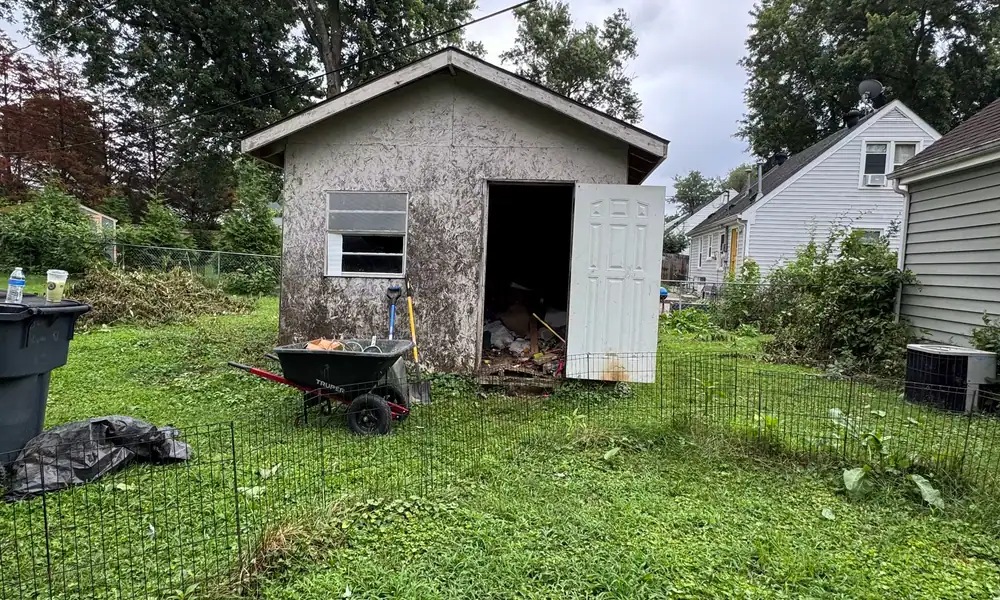
A small residential lot runs $400 to $1,200. A medium or heavily overgrown lot runs $1,200 to $3,500 or more. Full site preparation, including grading, runs $800 to $3,500 or more. Four variables move every one of those numbers: how much ground there is, how dense and heavy the vegetation is, how accessible the work area is for equipment, and the volume of material leaving with us.
Haul-off volume is the largest single cost component, which is precisely why most operators subcontract disposal and mark it up before it reaches your invoice. We run our own trucks and dumpsters, so that figure is known before the work starts instead of appearing afterwards.
Get an Expert Evaluation Before Anyone Starts a Machine
Do not let an operator choose your method based on which attachment is already on his carrier. Grade, soil type, vegetation species, access and your intended end use all determine the right approach, and those five factors cannot be assessed from a phone call or a satellite image.
Whether you need an overgrown pasture reclaimed outside Paris, a fence line recovered in Versailles, or full land clearing and site prep for a new build in Georgetown, we will walk the property and tell you what it actually needs, including when that answer is a method we do not provide.
Send two or three photos and your ZIP code and you get a firm number, free, guaranteed within two hours during business hours.
Call (859) 213-6077 or request a free site walk. Open Monday to Saturday, 8:00 AM to 6:00 PM, serving Lexington, Georgetown, Nicholasville, Richmond, Frankfort, Winchester, Versailles and Paris.